Much of the conversation around trading bots focuses on beginners: people who have never traded before, who need simple interfaces and hand-holding through their first bot setup. This framing is understandable — automation tools genuinely do lower the barrier to entry for new market participants.
But there is another category of user that often gets less attention: the experienced trader. The person who has been in crypto markets for years, understands technical analysis, knows what a funding rate is, has lived through at least one full market cycle, and has developed genuine trading intuition over time.
For this user, the question is not “how do I get started?” It is a different and in some ways harder question: “Is there a way to keep capturing market opportunities without the parts of trading that are grinding me down?”
This article is written for that trader. It examines the specific friction points that experienced traders face in manual trading, explains how algorithmic automation addresses them, and outlines how Botty is designed to work alongside existing trading expertise rather than replace it.
Key Takeaways
- Experienced traders face distinct problems that beginners do not: time constraints, emotional fatigue, the impossibility of 24/7 vigilance, and the compounding cost of routine manual work.
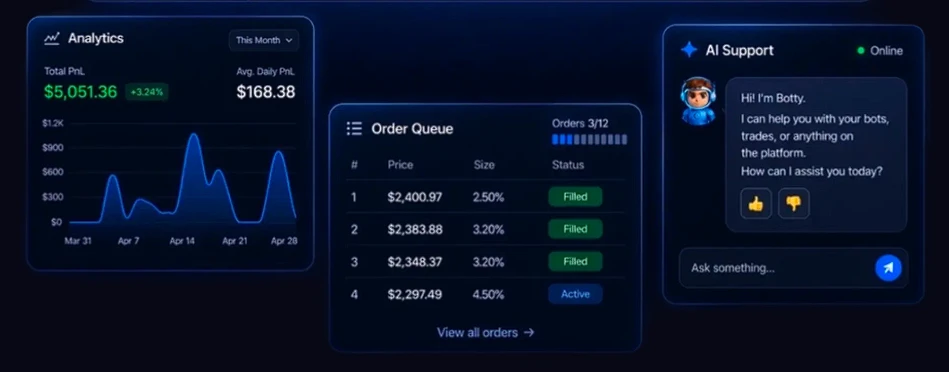
- A conservative bot on a well-configured grid strategy can execute 1,000+ trades in a year — a volume no manual trader can replicate consistently.
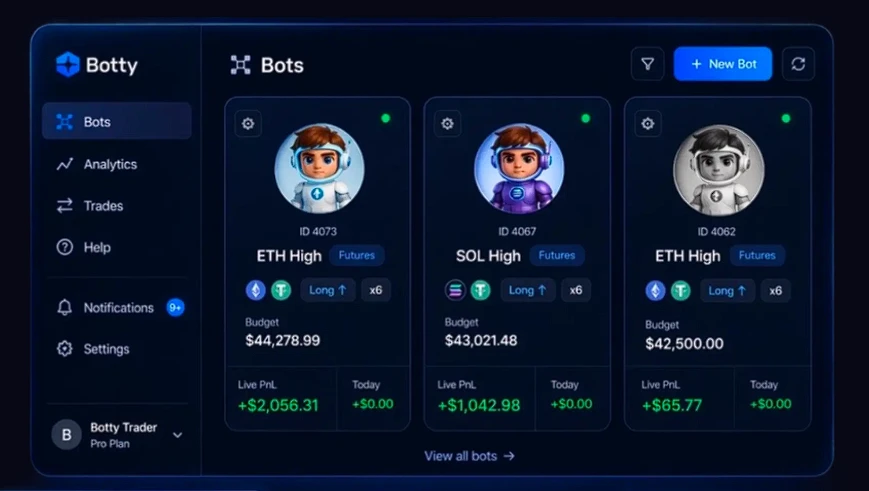
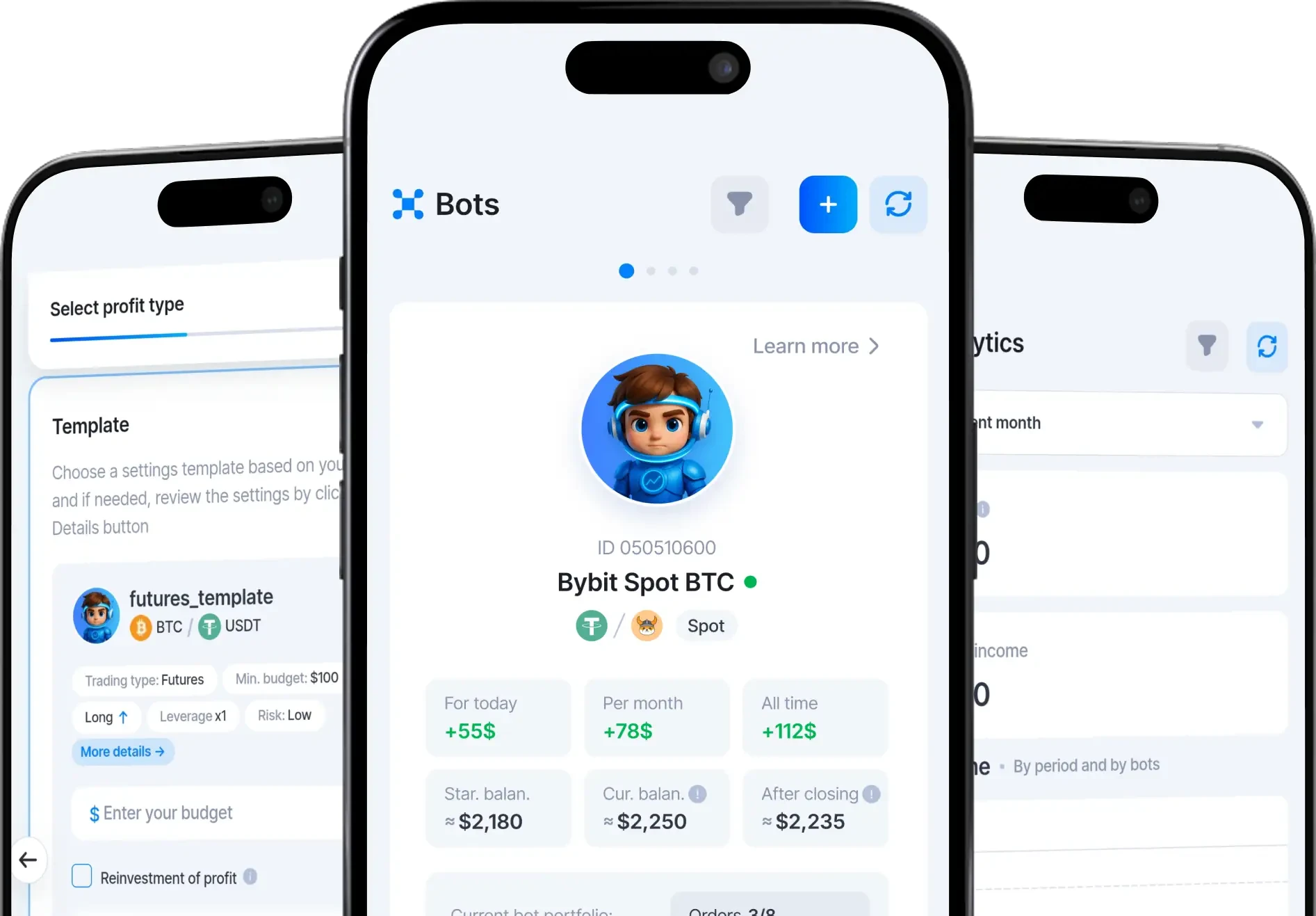
- Botty does not make independent decisions. It executes the logic the user configures. Experienced traders can customize templates or build their own settings from scratch.
- Copy trading — an alternative some experienced traders consider — has structural limitations that algorithmic automation does not share.
- The non-custodial model means the trader retains full control and can pause, adjust, or stop bots at any time.
- Algorithms do not get tired, do not get emotional after a losing trade, and do not miss entries because they were busy with something else.
- For traders with crypto assets sitting idle in spot holdings, bots can put that capital to work systematically instead of waiting passively for price appreciation.
The Hidden Costs of Manual Trading at Scale
Ask most experienced traders what their biggest constraints are, and the answers converge on a few themes: time, attention, and emotional consistency. These are not beginner problems. They are the ceiling that every manual trader eventually hits, regardless of their skill level.
Time is the most obvious constraint. The crypto market runs continuously — 24 hours a day, 7 days a week, 365 days a year. No human being can monitor it without interruption. Relevant price movements happen at 3am on a Sunday, during holidays, during family events, during the hours a trader needs to focus on their work or business. Every hour the trader is not watching the market is an hour of potential opportunity unobserved.
For someone trading their own capital as a primary or secondary income source, this creates a peculiar form of stress: the awareness that the market is always running, and that being away from it means potentially missing something significant. Some traders describe this as a background anxiety that never fully switches off — checking price alerts during dinner, glancing at charts before sleep, waking up to see what happened overnight.
Beyond time, there is the question of execution capacity. A human trader, working at a realistic pace, might manage dozens of trades in an active day. A well-configured algorithmic bot, operating on a grid strategy across multiple pairs, can execute hundreds. Over the course of a year, a conservative bot setup has been observed to close more than 1,000 trade cycles. The sheer volume of small, systematically captured moves is something manual execution cannot replicate — not because of skill, but because of the physical limits of human attention.
What Experienced Traders Actually Lose to Routine
There is a specific category of work in manual trading that is often underappreciated: pure operational routine. Placing orders. Moving stop-losses. Adjusting position sizes. Monitoring open trades. Reviewing P&L. Transferring profits. Rolling positions.
None of this work requires trading insight. It requires attention and time, but not the kind of analytical thinking that distinguishes a skilled trader from an unskilled one. Yet it consumes a significant portion of an active trader’s day.
The opportunity cost of this routine work is the strategic thinking it displaces. Time spent manually managing open positions is time not spent on market research, cycle analysis, or developing more sophisticated approaches. The most experienced traders often recognize that they are spending the majority of their working hours on execution mechanics rather than on the analytical work that actually generates their edge.
Automation does not eliminate the need for strategic thinking. It eliminates the operational burden that was previously attached to executing that thinking. A trader who spends two hours a day manually managing a grid of positions can, in principle, redirect most of that time to higher-value activities once a bot is handling the execution.

The Emotional Variable: Why Even Professionals Slip
The behavioral finance literature is extensive on the subject of emotional decision-making in trading, and experienced traders are not immune to it. In fact, some of the most costly emotional errors are made by people who are confident in their abilities — because confidence can manifest as overriding a pre-defined plan based on an intuition that turns out to be wrong.
The pattern is familiar: a trader enters a position according to their strategy. The market moves against them initially. They know intellectually that a period of drawdown is normal and expected within their strategy. But watching the loss accumulate triggers the same stress response that affects any human being. The rational response — wait for the strategy to play out — competes with the emotional response to act, to limit the pain, to do something.
Sometimes the emotional response wins. The position is closed early, locking in a loss that would have recovered. Or the trader adds to a losing position beyond the size their original plan called for, driven by the desire to average down faster. Or they miss the next entry because recent losses have made them hesitant.
These are not failures of knowledge or skill. They are failures of the human nervous system under financial stress — something every trader, at every experience level, is susceptible to. The emotional variable is not eliminated by years of experience. It is managed, with varying degrees of success, but it never disappears entirely.
An algorithm has no such variable. It does not feel the loss accumulating in an open position. It does not hesitate before the next entry because the last one was uncomfortable. It does not override its parameters because of a feeling. It simply executes the next instruction in its queue, consistently, regardless of what has happened before.
For experienced traders who have spent years working to manage their own emotional responses to markets, the appeal of a tool that removes the variable entirely — not manages it, but eliminates it — is significant.
How Algorithmic Automation Addresses These Problems
Botty’s automation framework addresses the experienced trader’s core pain points in a direct and practical way.
On the time constraint: once a bot is configured and running, it operates continuously without the trader’s active involvement. The market can move at 3am, on a holiday, during a vacation, and the bot will respond according to its parameters. The trader does not need to be present. They do not need to check price alerts every hour. The algorithm is present on their behalf, continuously.
On execution volume: the bot can place and close orders far faster and more frequently than any human. For grid strategies that capture small profits across a high volume of cycles, this mechanical advantage is significant. The strategy’s profitability is partly a function of the number of cycles completed — more cycles means more accumulated small gains. A bot operating without interruption across a full year will execute a multiple of the trades that any manual trader would realistically manage.
On the emotional variable: the bot does not have one. It does not deviate from its configured parameters based on recent losses, market sentiment, or the trader’s mood. This consistency is the closest thing to a guarantee that a trading system can offer: that the strategy will be executed as designed, not as fear or greed suggests in the moment.
On operational routine: the vast majority of the mechanical work involved in running a grid strategy — placing individual orders, monitoring levels, adjusting positions as the market moves — is handled by the bot. The trader’s ongoing involvement is primarily monitoring and strategic review, not execution.

What Botty Does That a Human Trader Cannot
Beyond solving existing problems, algorithmic automation enables things that are genuinely impossible for manual traders.
First, true 24/7 market presence. Not in the sense of “I try to check the market before bed” — but in the literal sense of continuous, uninterrupted participation. Every price movement, at every hour, is captured within the bot’s operating parameters. Opportunities that occur when the trader is asleep are not missed; they are executed automatically.
Second, simultaneous multi-pair operation. A single trader managing positions manually across BTC, ETH, and SOL simultaneously faces a significant cognitive load — tracking three different price feeds, managing three sets of positions, making three parallel sets of decisions in real time. A bot running on all three pairs simultaneously does so without any additional cognitive overhead. The scalability of automation is essentially unlimited in this respect.
Third, consistent parameter execution across thousands of trades. Over a year with 1,000+ completed cycles, a manual trader would inevitably introduce variation: slightly different position sizes, slightly different exit triggers, slightly different responses to similar situations. Over thousands of repetitions, this variation adds up and degrades the consistency of the strategy’s execution. A bot executes each cycle identically, by definition. The strategy is applied with perfect fidelity across every single trade.
Copy Trading vs Algorithmic Automation: A Key Distinction
Experienced traders evaluating automation tools often consider copy trading as an alternative: subscribing to a top trader’s strategy and having their trades automatically replicated on your account. It sounds similar to algorithmic automation, but the structural differences are significant.
Copy trading works by broadcasting the lead trader’s positions to all subscribers simultaneously. When the lead trader opens a position, all subscribers open the same position at approximately the same time. This creates a problem that scales with popularity: when thousands of accounts try to enter the same position at the same moment, the demand for that position drives the price in the direction of the trade. Subscribers do not enter at the same price the lead trader did — they enter into a market that has already moved against them.
The more popular the lead trader, the worse this problem becomes. A trader with 10,000 subscribers generates 10,000 simultaneous market orders when they open a position. The resulting price impact can be significant enough to eliminate the profitability of the original trade for the majority of those subscribers.

Maintaining Control: How Experienced Traders Use Botty
A legitimate concern among experienced traders considering automation is loss of control. Manual trading, whatever its drawbacks, gives the trader direct authority over every decision. Delegating execution to a bot feels, to some, like surrendering that authority.
Botty’s architecture addresses this directly. The platform is non-custodial: all funds remain on the user’s exchange account at all times. The bot connects via API with trade-only permissions — it cannot withdraw funds, cannot transfer balances, and cannot take any action outside the parameters it has been configured with. The trader retains full access to their exchange account and can pause, adjust, or shut down any bot at any time.
For experienced traders, the platform’s customization options are also relevant. While Botty’s ready-made templates are designed to be deployable without modification, users with trading experience can adjust every parameter: grid range, order distribution, profit targets, leverage settings, capital allocation per bot. This means the automation is executing the trader’s own strategy — not a generic template — with the consistency that manual execution cannot maintain.
The bot is best understood as a precision execution layer, not a decision-making replacement. The trader decides the strategy: which asset, which market phase interpretation, which risk parameters. The bot executes that strategy flawlessly, continuously, without fatigue or emotion. The strategic intelligence remains with the trader; the operational burden transfers to the algorithm.

For Traders With Idle Crypto Holdings
There is a specific use case for experienced traders that deserves particular mention: putting existing crypto holdings to work more actively.
Many experienced participants in the crypto market hold significant positions in BTC, ETH, or SOL that are essentially passive — bought and held in anticipation of long-term price appreciation. These holdings generate returns only if the price appreciates. During sideways or consolidating markets — which can last months — they generate nothing.
A spot bot running on an existing BTC or ETH holding can generate returns during exactly those sideways market conditions that passive holding cannot. The grid strategy captures the volatility within the range — the up-and-down price movements that occur even when the asset is not making significant directional progress — and converts that volatility into closed profitable trades.
This does not require selling the underlying holding. The bot’s capital is deployed from the exchange account alongside the existing position. The trader retains their long-term BTC or ETH exposure while the bot generates additional yield from the market’s intraday and intraweek volatility. In favorable conditions, this approach can substantially increase the total return on an asset position compared to passive holding alone.

What the Track Record Shows
For experienced traders who apply professional skepticism to platform claims, the relevant data points are worth examining directly.
Botty’s algorithms have operated continuously in live market conditions for more than three years. This is not a backtest period — it is real trading, with real capital, across real market conditions including the significant volatility of 2022, the recovery and rally of 2023-2024, and the elevated price environment of 2025-2026. The strategies have been tested against bear markets, bull markets, flash crashes, and extended sideways phases.
The platform’s aggregate trading volume has reached $1.5 billion in peak monthly figures. This is a measure of the scale of real activity, not projected or simulated performance. The algorithms underlying the templates were developed and refined through the trading experience of more than 30,000 real users across the platform’s predecessor community — a dataset that provided iterative feedback on strategy performance across diverse market conditions.
None of this constitutes a guarantee of future performance. Markets evolve, and conditions that supported strong historical returns may not repeat. But for an experienced trader evaluating whether an automation platform has been genuinely stress-tested in real conditions, these figures provide meaningful context.

Conclusion
Experienced traders often dismiss automation tools as something for beginners — training wheels for people who do not yet know how to trade. This is a misreading of what automation actually offers.
The case for algorithmic trading among experienced traders is not about compensating for a lack of knowledge. It is about solving the specific constraints that market knowledge alone cannot overcome: the impossibility of continuous market presence, the ceiling on manual execution volume, the inescapable emotional variable, and the operational burden of routine that displaces higher-value analytical work.
Botty is not designed to tell experienced traders what strategy to run. It is designed to execute whatever strategy they have developed with a consistency and scale that manual trading cannot match. The trader’s expertise defines the parameters; the algorithm eliminates the friction in executing them.
For traders who have spent years building market understanding and want to deploy that understanding more effectively — without the parts of trading that grind, exhaust, and emotionally destabilize — algorithmic automation is worth serious consideration. Not as a replacement for expertise, but as the most efficient use of it.
Trading cryptocurrency involves significant risk. Past performance does not guarantee future results. Results depend on market conditions, chosen settings, and individual capital management decisions.