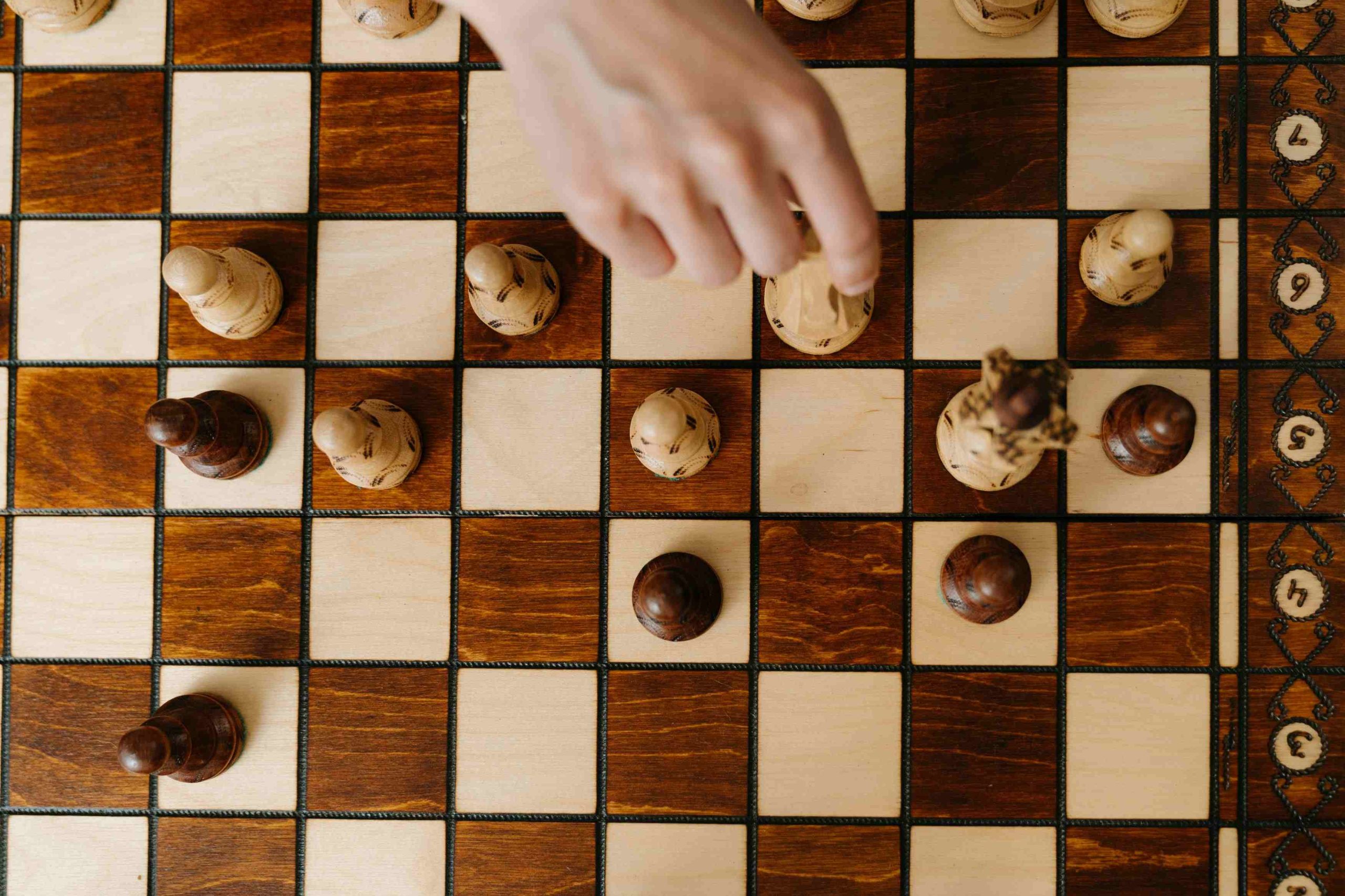
When someone plays their first game of chess, it rarely resembles what we see on grandmaster boards. Moves feel instinctive, chaotic, or copied from others. There is no real sense of plan—just a reaction to threats, a chase after material, or a search for quick checkmates. But over time, something changes. The board stops being a battlefield of guesses and starts becoming a space for logic, structure, and vision. What separates strong players from beginners is not some hidden talent, but a gradual refinement of thought. Chess thinking evolves, step by step. And just like in language or music, growth happens not in sudden leaps but through patterns of experience, feedback, and deliberate training.
Instincts and Chaos — The Beginner’s Stage
The first stage of chess thinking is marked by improvisation. Most beginners approach the game without a clear method. They may know how the pieces move, but not why one move is stronger than another. Decisions are reactive rather than intentional. A hanging piece is taken. A check is played without calculation. Openings are memorized without context—or invented on the fly. These games are not meaningless, though. They are the raw material from which all learning begins.
At this level, victories often come from basic tactics or the opponent’s blunders. A mate in one may be missed, a queen might hang, or a back-rank trick ends the game. But even in this early phase, the brain is gathering patterns. The player starts to notice that certain mistakes are punished repeatedly. Over time, they begin to anticipate danger—not always correctly, but more often than before. Intuition is slowly being shaped into recognition.
What’s most important at this stage isn’t knowledge—it’s exposure. The more games a beginner plays, the more situations they encounter, and the more they start to internalize basic cause-and-effect relationships on the board. Although their thoughts are scattered and unsystematic, they are forming the neural foundation for future growth.
- Moves are made with little long-term planning or purpose.
- Players struggle to see threats beyond one or two moves.
- Games often revolve around material grabs and short tactics.
- Openings and endings are poorly understood or improvised.
- Blunders are frequent, but each one carries a lesson.
This phase may feel chaotic, but it is essential. Without this period of trial, error, and play, structured thinking cannot emerge. The key is to move forward—not by skipping ahead, but by learning to recognize the patterns hidden within the chaos.
Mechanics and Calculation — Entering Structure
As players progress past their initial experiences, their thinking begins to shift. Instead of reacting blindly, they start to recognize recurring ideas—forks, pins, simple mating nets. Patterns emerge, and with them comes a desire for structure. At this stage, chess stops being a series of random exchanges and begins to resemble a system with internal logic. Players start asking, “What is my opponent threatening?” or “What happens after this move?” This is the birth of calculation.
Mistakes are still frequent, but they carry more meaning. The beginner’s fog lifts slightly, revealing the importance of tempo, piece activity, and material balance. Suddenly, losing a game isn’t just frustrating—it becomes a puzzle to solve. Where did the position collapse? Could something have been done differently ten moves earlier? These questions mark the beginning of deeper cognitive engagement.
Reaching this transitional phase often leads to frustration, as players begin to notice gaps between their intentions and execution. The board is no longer random—it demands structure, evaluation, and discipline. Many find themselves repeating the same mistakes without understanding why. At this critical juncture, guidance from experienced chess coaches can dramatically accelerate growth. Instead of trial and error, students receive frameworks for calculation, pattern recognition, and decision-making under pressure. A coach doesn’t just correct errors—they introduce thinking models that help players turn reactive moves into deliberate strategy.
Most importantly, the player begins to approach the board with a mindset of responsibility. Each move is a decision, not a guess. And with that comes a new kind of mental discipline: the ability to slow down, evaluate, and commit to a plan.
- Evaluation of trades based on value, activity, and coordination begins to matter.
- Players learn the importance of open files, central control, and safe king positions.
- Calculation becomes more deliberate, even if shallow at first.
- Learning from losses takes on structure—games are reviewed, not discarded.
- The first personal “opening repertoire” may begin to form.
This stage lays the groundwork for everything that follows. It builds discipline, introduces method, and turns chaos into a learning environment. The difference is no longer just between good and bad moves—but between random play and strategic intention.
Strategic Thinking and Long-Term Planning
At a certain point in a player’s journey, the focus shifts from tactics to plans. Moves are no longer played in isolation but become part of a larger idea. Questions like “Where should my pieces go?” or “What is the long-term weakness in this position?” begin to replace narrow calculations. This marks the transition to strategic thinking—a stage where players don’t just react to the present but shape the future.
Understanding pawn structures becomes crucial. The position of pawns defines the landscape of the board—dictating which squares are weak, which diagonals are open, and which pieces are effective. Players begin to appreciate the value of space, time, and flexibility. A move isn’t just “correct” because it wins material—it’s good because it improves a position, restricts the opponent, or prepares future activity.
Classic games often become a major resource at this level. Players start to study how great minds of the past built up pressure over 30 moves, maneuvered behind closed positions, or created imbalances out of quiet openings. Imitation turns into inspiration. The logic behind a move becomes as important as the move itself.
- Plans are made with 5–10 moves in mind, not just 1–2.
- Evaluating weaknesses, strong squares, and open files becomes second nature.
- Material sacrifices are considered when justified by strategic aims.
- Players actively look for piece coordination, not just individual strength.
- They begin thinking not only of “what to do” but “why now?”
Strategic players begin to notice that the best games feel effortless—not because they are simple, but because each move fits naturally into a larger design. The board is no longer a set of 64 independent squares; it becomes a living structure where every detail matters. This is where chess stops being a collection of tricks and starts becoming an expression of thought.
Self-Reflection and Cognitive Maturity
As players approach higher levels of understanding, their relationship with the game transforms. Chess is no longer just a sequence of plans and calculations—it becomes a mirror for their own habits of mind. They analyze not only the position on the board, but also how they arrived at their decisions. Why did they miss that idea? Why did they overestimate the danger? This stage is defined by meta-awareness: the ability to think about one’s own thinking.
This reflection leads to more personalized improvement strategies. Players begin tailoring their training not just by rating gaps, but by cognitive tendencies. Some may struggle with impulsivity, others with hesitation. Some rely too heavily on calculation, while others default to static evaluations. The question shifts from “What opening should I learn?” to “What is holding me back—and how do I address it?”
Guides on how to get better at chess become more meaningful when a player knows what they’re actually trying to improve. It’s no longer about collecting more knowledge—it’s about refining thought patterns. The training process becomes highly intentional: solving specific types of positions, reviewing annotated games with a focus on critical moments, or building routines that enhance pattern recognition without burning out.
- Players review their games not for ego, but for insight.
- Blunders are categorized—not just noted—so patterns can be broken.
- Coaching, books, and engines are used strategically, not passively.
- Time management becomes part of the thinking model, not just clock control.
- Flexibility replaces rigidity—what worked yesterday may not work tomorrow.
In this phase, chess thinking is more dynamic, more adaptive. Success depends less on knowing the “right” plan, and more on choosing the right plan for the situation. With maturity comes humility—and the understanding that mastery is less about certainty than about continuous learning.
Integration and Strategic Autonomy
At the highest stage of chess thinking, something subtle but powerful occurs: everything that was once studied in parts—tactics, strategy, psychology, calculation—begins to merge into a single, fluid process. The player no longer shifts between “thinking modes.” Instead, decisions emerge from an integrated awareness of the entire position, shaped by instinct, refined by experience, and guided by principle. The mind acts with clarity even in chaos.
This level of thinking is not about perfection. In fact, it embraces uncertainty. The strongest players know when a position demands flexibility rather than depth, when it’s better to preserve practical chances than seek objective truth. Intuition—once the tool of the beginner—is reborn, now informed by thousands of patterns and hundreds of battles. It’s no longer a guess; it’s the crystallization of silent knowledge.
Strategic autonomy means the player is no longer reliant on rote ideas or external input. They can build original plans, adjust mid-game, and make sense of unfamiliar positions with composure. The opening doesn’t need to follow theory. The endgame doesn’t need memorization. What remains is a mental language so fluent that even complex positions feel navigable.
This stage also allows players to understand the psychological layers of competition. They read the tempo of the game, sense when an opponent is uncomfortable, and create positions that test specific mental traits. Chess becomes as much about human insight as it is about position evaluation.
Ultimately, this is not a finish line. Even the best players revisit earlier stages—refining calculation, reassessing planning principles, retraining focus. But what changes is how all these elements come together: effortlessly, decisively, and with a clarity that defines true mastery. It’s not that strong players never err—it’s that they know how to recover, adapt, and transform every move into part of a greater whole.
Thinking That Transcends the Board
The journey from novice to strategic thinker in chess mirrors a deeper transformation. It’s not only about understanding moves, patterns, or positions—it’s about evolving the way we process information, assess complexity, and make decisions under uncertainty. Chess develops thinking that adapts, reflects, and grows. And while not every player will become a master, every thoughtful game becomes part of a larger story: the story of a mind learning to think better. From casual play to competitive ambition, chess remains one of the rare tools that sharpens not only skills, but character. For those willing to engage deeply, the board offers far more than checkmates—it offers a lifelong path toward clarity, discipline, and insight.